Four field measurements on three existing buildings, documented studies and testimonials from the field. Each figure states the conditions under which it was obtained.
Four measurement series on three properties
The interior surface temperature was measured before and after application. Two of the four series come from the same building, measured under different conditions. The figures document the result for these three properties, not a universal temperature increase.
Measurement method: surface temperature measurement on the inside of the external wall, always at the same measuring point before and after coating, during the heating season. The boundary conditions for each property are given in the table and on the images below.
Values as a table
Wall surface temperature before and after coating. All values: field measurement, heating season.
Property
Boundary condition
before in °C
after in °C
Difference in K
Basis
Residential building, built 1890
outside 2–5 °C, inside 20 °C
12,0
19,0
+7,0
Field measurement
Residential building, built 1900
Solid brick 400 mm, outside 0 °C
12,9
19,0
+6,1
Field measurement
Residential building, built 1900
Flow temperature constant 36 °C
12,3
18,6
+6,3
Field measurement
Residential building, built 1960
Concrete, ceiling heating, outside 4 °C
11,0
19,0
+8,0
Field measurement
Reference line: 12,6 °C minimum surface temperature. It follows from the requirement fRsi >= 0,70 per DIN 4108-2 under the boundary conditions standardised therein (20 °C indoor air, -5 °C outdoor air). The boundary conditions of the three properties differ from this; the line serves as a point of reference. The four value pairs are measured on site.
Source: our own field measurements at four existing buildings during the heating season. The dashed reference line is the standard value per DIN 4108-2.
Documented studies
Three properties where the build-up was examined and the U-value determined before and after. The figures apply to the specific build-up examined and are not a guarantee for any given existing component.
Study 01
Reinforced concrete frame building
A multi-family building was coated with a 1 mm layer of PowerSmartCoat.
U-value
before 2,632after 0,096
Interior surface
before 13,0 °Cafter 19,7 °C
Condensation
before significantafter none
U-value reduced by around 96%
Study 02
Petrochemical storage tanks
Investigation of the effect on petrol storage tanks in ongoing operation.
Tank temperature
before conventionally insulatedafter 2°C lower
Evaporation
before Reference valueafter lower losses
Reduced evaporation losses
Study 03
Listed heritage façade
Comparison with conventional insulation materials on a listed heritage façade.
Layer thickness
before 15–20 cm EPS WLG 031after 1 mm coating
Insulating effect
before Reference valueafter higher
Faster payback
Thermal images
The corresponding thermal images
One image of the property per measurement series. A thermal camera rescales its colours for each image — so the displayed measurement points are comparable, not the colours.
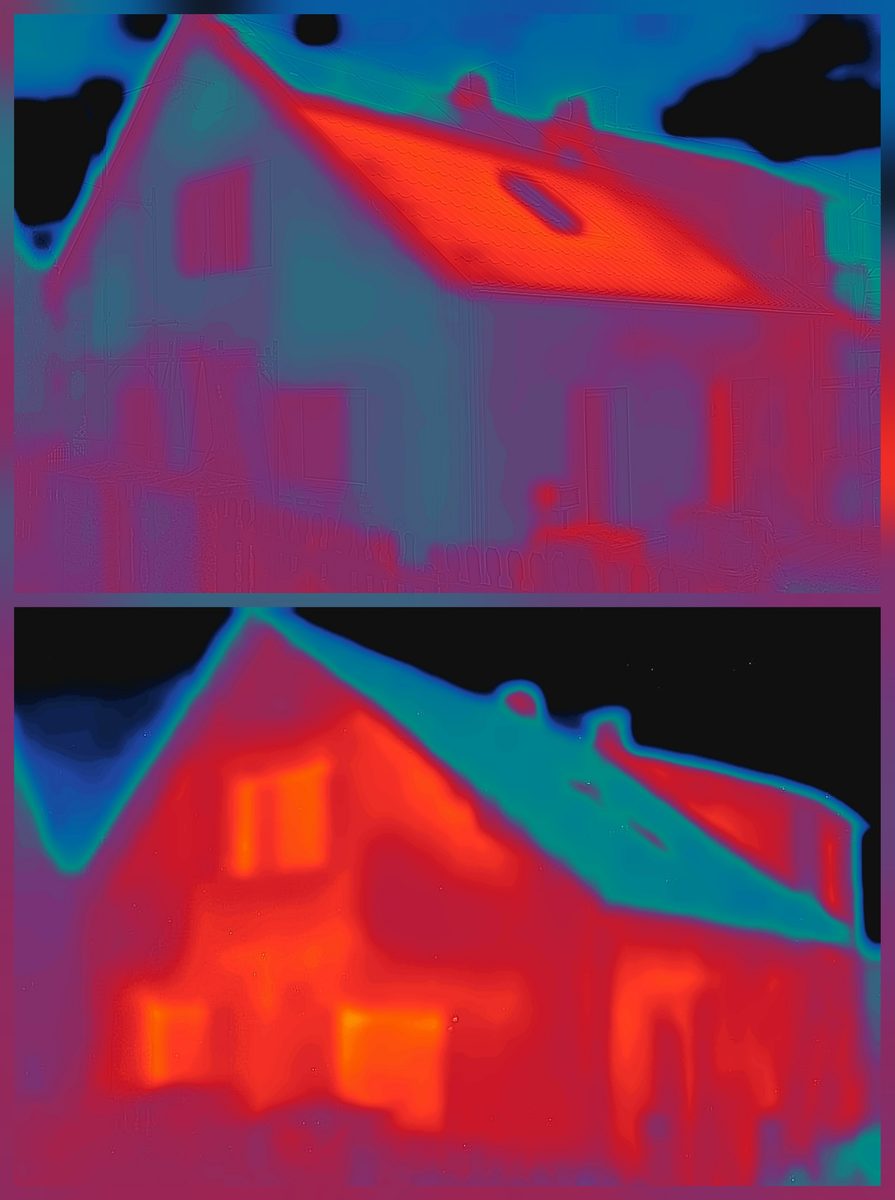
Residential building, built 1890
Outdoor temperature
2 °C / 5 °C
Room temperature
20 °C
Wall surface
12 °C → 19 °C
Two images of the same façade before and after coating, under comparable winter conditions. The building previously required high heating output and still did not get warm. Annual heat demand fell from around 40,000 kWh to under 15,000 kWh.
Residential building, built 1900 — solid brick
Outdoor temperature
0 °C
Room temperature
20 °C
Wall surface
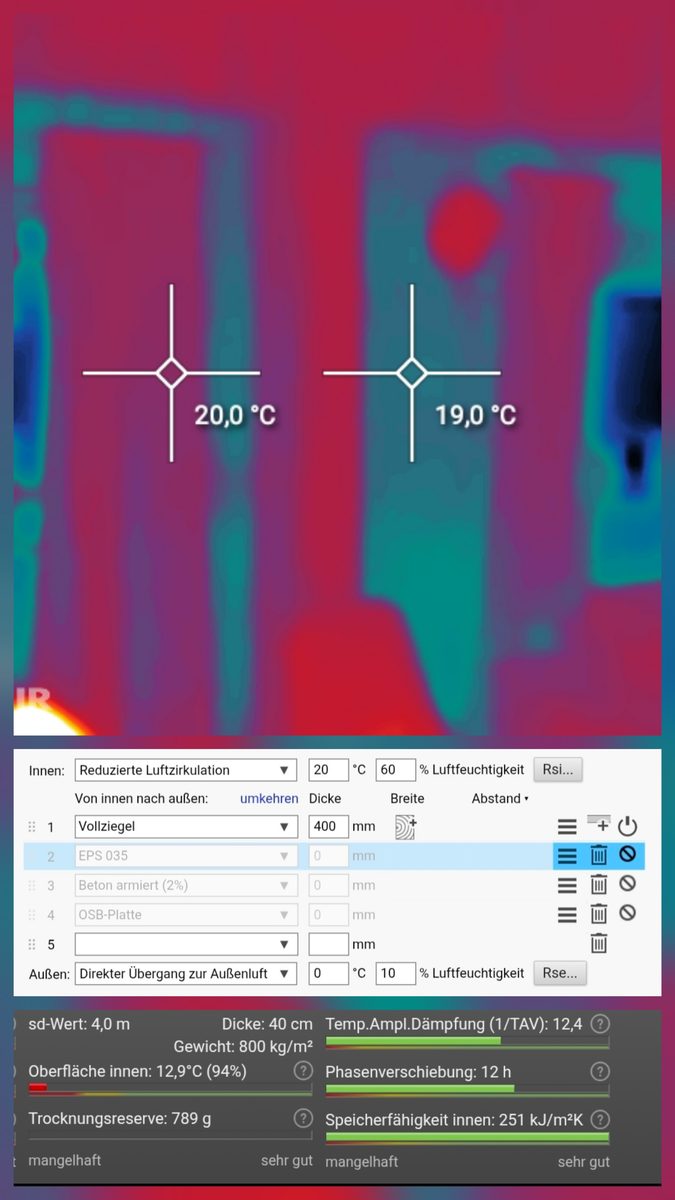
12,9 °C → 19 °C
Wall structure
Vollziegel, 400 mm
The image compares room air — measured at the curtain, 20.0 °C — with the external wall next to it: 19.0 °C. Below it is the component calculation for exactly this wall. It predicts 12.9 °C on the inside and rates the wall as deficient. The measured value was 19.0 °C.
Residential building, built 1900 — same flow temperature
Outdoor temperature
5 °C → 3 °C
Room temperature
16 °C → 20,5 °C
Wall surface
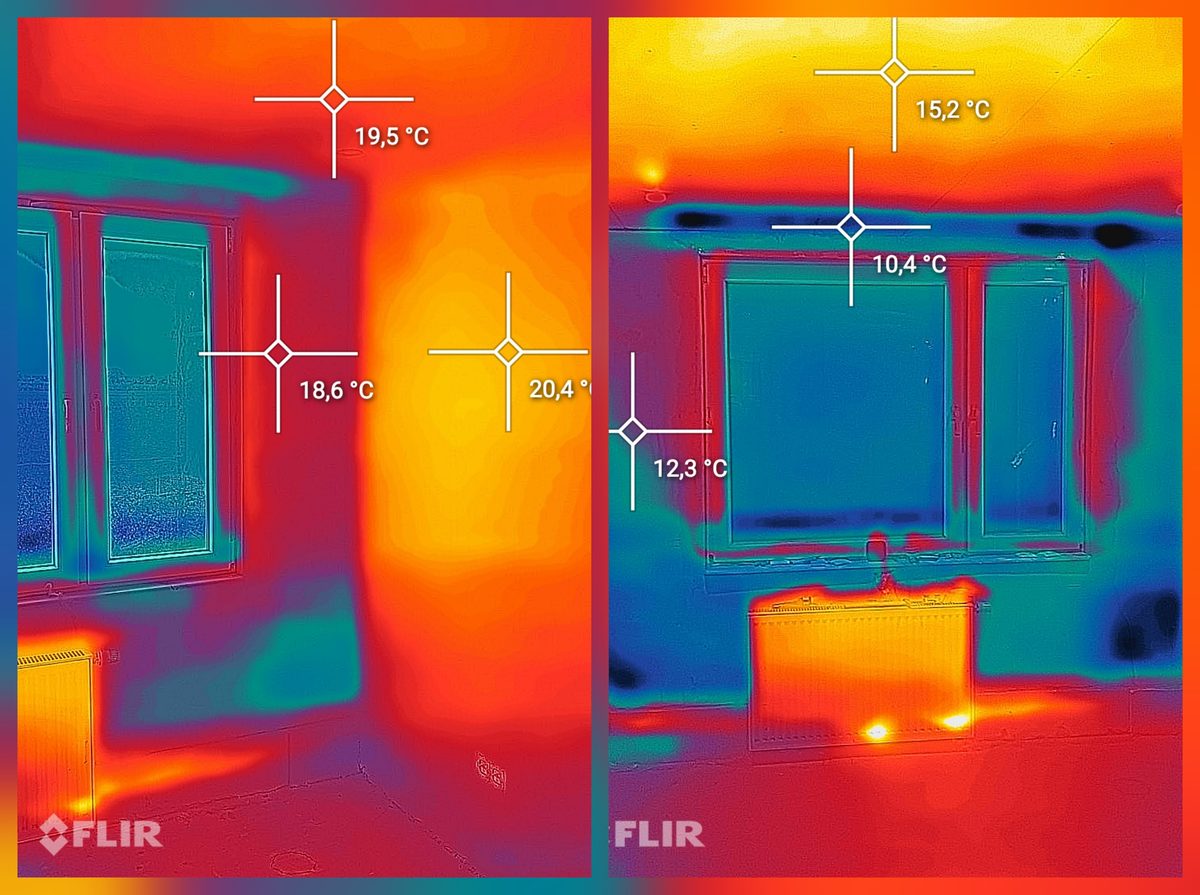
12,3 °C → 18,6 °C
Flow
konstant 36 °C
Both images at the same flow temperature. On the right, the starting situation with 10.4 °C at the concrete lintel above the window and 12.3 °C at the wall; on the left, the same spot afterwards with 18.6 °C to 20.4 °C. The thermal bridge at the lintel recedes even though the heating runs unchanged.
Residential building, built 1960 — concrete frame
Outdoor temperature
4 °C
Room temperature
20 °C
Wall surface
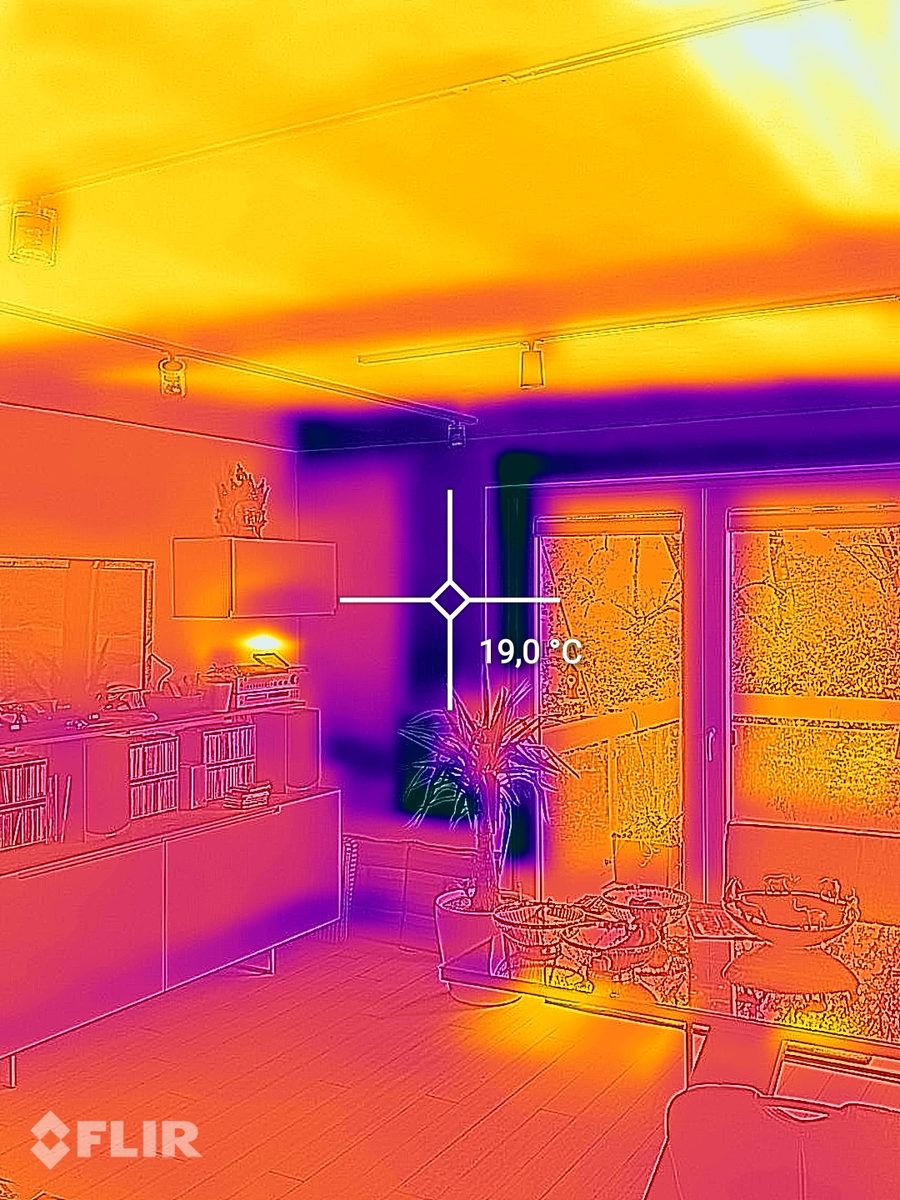
11 °C → 19 °C
Heating
Deckenheizung
The load-bearing concrete structure remains visible in the thermal image. Despite the high thermal conductivity of concrete, 19.0 °C is measured at these critical points; the thermally more favourable brick infill panels now differ only slightly from the internal wall on the left of the image.
Industry
In industrial use
The coating has been used in industrial plant engineering for years — on pipelines, tanks, and halls. The following companies use it in their facilities.
Refining and chemicals
CHEVRON
ORLEN
SLOVNAFT
MOL
AZOTY GROUP
AGROFERT
SYNTHOS
Power plants, district heating, water supply
VEOLIA
MAVIR (Almásfüzitő, HU)
WĘGLOKOKS (PL)
ZEM (PL)
EC MIKOŁAJ (PL)
PLYNEX / VAE Controls
Industrial gases
Air Liquide
Air Products
LINDE
Automotive industry
OPEL
CONTINENTAL
Mining and smelting
KGHM Polska Miedź
Koksownia Częstochowa (ZARMEN G.A.)
Renewable energy
UWC (Thailand)
GREEN GAS
Food, construction, defence technology, real estate
HEINEKEN
TEMPEST HOLD (SK)
VÝVOJ Martin (Czechoslovak Group)
FUJI (DE)
EL-GROUP (DE)
From the field
Customer experiences
Businesses that have worked with the coating — in their own words.
Thanks to the coating, we were able to raise the interior temperature of an office from 6–12°C to 19–21°C with the same heating output. This meant the poorly insulated room could be used again.
Rewe GroupOffice building project
The straightforward application and the impressive results convinced us. Our customers are delighted.
Schmidt & SohnSpecialist application contractor
References
Partners near you
The map shows the locations of our applicators and sales partners.
Alexandra HeinrichCertified customer advisorTel.: +49 179 4222 543Email: alexandra.heinrich@pscoat.net
BEST BAU GmbHExecuting painting and decorating contractorE-Mail: info@bestbau24.deTel.: +49 163 6076902https://www.bestbau24.de/
CK Bau & CleanExecuting trade contractorE-Mail: tobias.wagner@pscoat.netTel.: 0176 6154 4390
Christian RieraCertified customer advisorE-Mail: christian.riera@pscoat.deTel.: +49 176 55246159
Only the basket, session and payment processing are necessary — these always run. In addition, we would like to measure which advert led to an enquiry. To do this, your browser transmits the page view to our measurement provider, Whop, Inc., in the USA; we also record which search engine or referrer you came from. This requires your consent; it is voluntary and can be withdrawn at any time. More in the privacy policy.